

Custom-Made Spout Pouch Manufacturer for Premium Flexible Packaging Solutions
2026-10-31
In a market flooded with rigid containers and conventional pouches, custom-made spout pouches have quietly become the packaging choice for brands that refuse to compromise on functionality or shelf presence. Yet finding a manufacturer who truly understands the nuances of premium flexible packaging—from barrier films to spout fitment precision—is rarer than it should be. That’s where Kody steps in, not as another supplier, but as a partner obsessed with the details that make your product pour perfectly and stand out boldly. This article unpacks what sets a top-tier spout pouch maker apart, and why Kody’s approach might just change how you think about flexible packaging.
Custom Spout Pouches Built Around Your Product
Your product isn't a one-size-fits-all item, so its packaging shouldn't be either. We start with your liquid or semi-liquid's actual behavior—viscosity, acidity, sensitivity to light or oxygen—and shape the spout pouch from there. The spout diameter, film layers, and gusset depth get tuned to how your customers will pour, squeeze, or reseal, not to whatever stock size happens to be on the shelf.
That kind of tailoring shows up in small, practical ways. A thicker sauce might need a wider spout and a stiffer film structure so it doesn't bloat on the shelf. A supplement shot may call for a slim, contoured pouch that fits neatly in a pocket or gym bag. Even the placement of the spout—center, corner, or off-set—gets adjusted to match the way the pouch is held and opened in real life.
Because every dimension is built around your product's specs, you avoid the usual workarounds: no overfilling to compensate for awkward headspace, no extra corrugated inserts to keep pouches from slouching. The result is a pouch that looks intentional on the shelf and performs the way your product actually needs it to.
Premium Films and Spouts for Demanding Contents
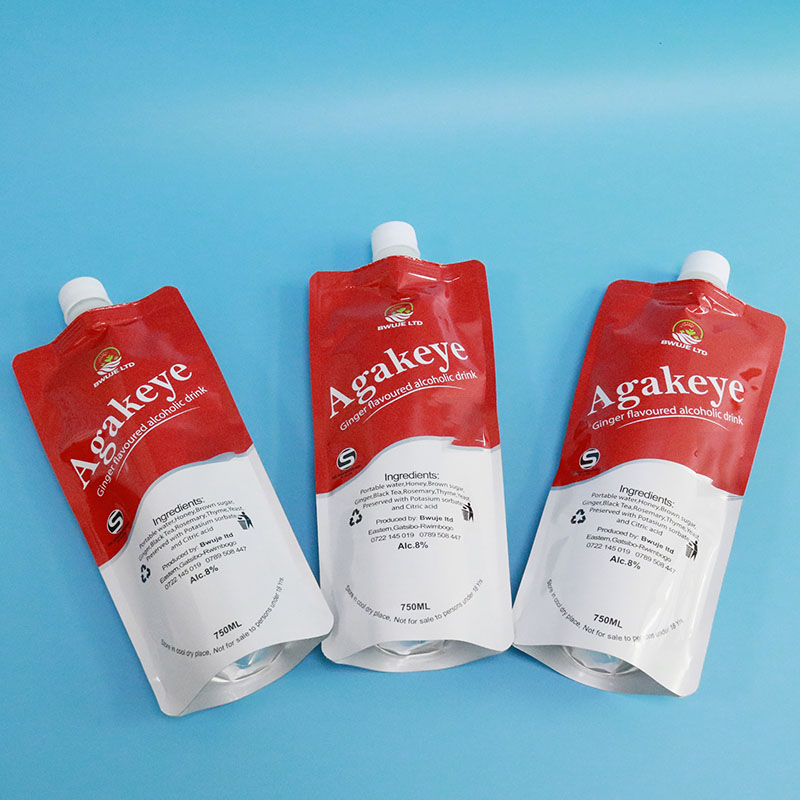
Packaging aggressive or hard-to-handle contents leaves little room for compromise. The films used here combine dense barrier layers with enough flex to avoid cracking at fold points, while the spouts are engineered to seal tightly and dispense cleanly even with thicker or more reactive products. Rather than relying on a single generic structure, these materials are tuned to match viscosity, pH, and fill speed.
Spout choice matters just as much as film composition. A well-matched spout reduces product hang-up, prevents air pockets during filling, and holds its shape after repeated opening and closing. For contents that degrade quickly or stain surfaces, the film's inner layer and the spout's contact surfaces are selected to resist absorption and discoloration, so the package performs consistently from first use to last.
Print and Finish Options That Make Your Brand Stick
Think about the last business card you actually kept. Chances are it wasn't the flimsy, uncoated one that bent in your pocket. It probably had a soft-touch laminate, a raised spot UV logo, or a subtle embossed edge that made you run your thumb over it. Those details are not decoration; they are memory triggers. A matte finish with a high-gloss accent on just the logo creates contrast and tells the eye where to land, while a textured stock invites touch before a word is read.
Foil stamping is another underused tool. A thin copper or holographic line along a business card or a notebook cover catches light in a way flat ink never can. But restraint matters more than shine. Instead of foiling the whole name, try applying it only to the first letter or a small icon. That single glint can make people pause, flip the piece over, and feel the impression on the back—proof that the finish is physically part of the paper, not just printed on top.
Edge painting, die-cut shapes, and duplexed paper can push a brand further. A stack of flyers with neon green edges turns a stack into an object. A brochure with a die-cut window teases the content inside. These choices don't need a big budget; they need a clear point of view. Pick one finish that aligns with the brand's personality—say, a gritty uncoated stock for a workshop, or a high-gloss spot UV for a tech product—and repeat it across all print materials. Repetition is what makes a finish stick.
Flexible Packaging That Survives Distribution and Dispensing
Flexible packaging gets bumped, stacked, dropped, and squeezed long before it reaches a shelf. The films that make it through are rarely single-layer. They combine polyethylene, polyester, nylon, or foil in ways that balance puncture resistance with controlled tear. A bag for liquid detergent might use an inner layer that seals at high speed and an outer layer that shrugs off conveyor abrasion. Distribution tests often include repetitive vibration, drop cycles from two meters, and compression under 300 kilograms to catch weak seals before a truckload leaves the plant.
Dispensing adds another layer of abuse. Spouts, fitments, and press-to-close zippers have to stay attached through temperature swings and rough handling. A stand-up pouch with a corner spout needs a seal area that won’t delaminate when someone torques the cap open one-handed. The best designs reinforce the fitment zone with a secondary film patch or use a heat-seal coating that tolerates oily products. Resealable openings also get tested for repeated cycles—some zippers fail after five uses, while better ones survive fifty without losing their snap.
Real-world failures usually happen at the intersection of distribution and dispensing: a pallet leans in a hot trailer, the film softens, and a spout pops loose. That’s why spec sheets now list heat creep resistance and seal strength after conditioning at 50°C. It’s not enough to survive a drop test in a lab. The package has to keep its shape on a bumpy last-mile van and still pour cleanly when the consumer finally opens it at home.
A Transparent Process from Concept to Production
You won't find a black box here. Every sketch, material choice, and design revision stays visible from the first rough idea to the day your product leaves the line. We share timestamps, supplier details, and even the rejected prototypes, so you can see exactly why a seam moved or a finish changed. That kind of openness is rare, but it's the only way to build something you'll actually trust.
The same principle applies once manufacturing begins. Instead of handing off a spec sheet and hoping for the best, our team records each production stage with notes and photos, then passes that record straight to you. If a batch runs into a delay or a component needs a last-minute swap, you'll know before it affects the schedule. The point isn't just to keep you informed, it's to make the whole journey feel like a conversation, not a handoff.
Responsive Manufacturing for Niche and Growing Brands
Small-batch runs no longer mean compromising on speed or finish. A responsive production line can shift from 500 units of one SKU to 2,000 of another within the same week, letting niche brands test new colorways or limited drops without warehousing excess inventory. The real value shows up when a cult product suddenly spikes after a single influencer mention; instead of waiting eight weeks for overseas restock, the line reallocates capacity and ships replenishment in days, not months.
For growing labels, the challenge is rarely the first order—it is the messy middle where demand swings between 300 and 3,000 units per month. Responsive manufacturing treats that range as normal rather than exceptional. Tooling is designed for quick changeovers, quality checks happen inline rather than at the end of a batch, and raw material buffers are sized to absorb variability without inflating working capital. That means a brand can launch a new fragrance, gauge reaction, and scale the second run by 40% without renegotiating minimums or losing shelf placement.
The payoff is not just logistics. When production adapts to actual sell-through, niche brands keep their identity intact—small drops, unusual materials, regional exclusives—while still meeting retailer delivery windows. It turns manufacturing from a bottleneck into a creative asset, where the next idea can become a finished product in under three weeks.
FAQ
We don't just glue a spout onto a stock pouch. Every order starts with your product's viscosity, fill temperature, and shelf-life requirements, then we choose the film structure, spout diameter, and sealing layer accordingly. You can even request corner spouts or top spouts with different cap styles.
Yes, within reason. We have over 200 pouch shapes on file, but if none fit, our in-house dieline team will draft a new one from scratch. Keep in mind that unusual shapes may need a custom forming collar, which adds a bit to tooling cost.
We work with PET, PET/AL/PE, PET/NY/PE, and high-barrier clear films. For hot-fill or retort products, we switch to retort-grade cast polypropylene inner layers. If you need a matte or soft-touch finish, that's also available.
For a fully custom printed spout pouch, the minimum is usually 10,000 units per SKU. For blank pouches that you label yourself, we can go as low as 5,000. If you're just prototyping, we offer a short-run digital option at 500 pieces.
Every spout is tested before and after sealing. We use a burst tester and a vacuum leak tester on every batch, and we also do a 24-hour dye penetration test on random samples. The spout fitment is fusion bonded to the inner layer, not just heat sealed on the surface.
Most of our work comes from liquid foods, beverages, sauces, and personal care. But we've also produced spout pouches for automotive fluids, pet shampoos, and even concentrated cleaning gels. If it flows or can be squeezed, we've probably made a pouch for it.
After you approve the digital proof, production takes about 3 to 4 weeks. If you need a faster turnaround, we can hold capacity for a 10-day rush order on certain stock films. Shipping time is separate, of course.
Yes. We offer mono-material PE spout pouches that are fully recyclable in many store-drop-off programs, and we also have a compostable option using bio-based films. Note that the spout itself is usually still plastic because a compostable spout doesn't hold up to liquid products yet.
Conclusion
Every product has its own shape, viscosity, and shelf-life story, and a spout pouch should be designed around those realities rather than forcing a standard format onto them. That is the thinking behind this custom manufacturing approach: pouches are built from the ground up to match your contents, whether it's a thick smoothie, a liquid detergent, or a delicate baby food. High-barrier films and precision-matched spouts are selected for compatibility with demanding formulas, preventing leaks, preserving freshness, and standing up to repeated use. Meanwhile, the printing and finishing stage moves beyond basic labels. Matte or gloss varnishes, tactile soft-touch coatings, metallic accents, and high-resolution graphics are combined to give the pouch a distinct presence on crowded shelves. The idea is that the package doesn't just hold the product; it becomes part of the brand's identity from the first glance.
A pouch that looks great on a screen still needs to survive real-world logistics. Drop tests, compression during transport, and the wear of dispensing nozzles are all considered during prototyping, with materials and seal designs adjusted accordingly. The production process itself stays open and collaborative, from initial concept sketches through sampling to final delivery, so you always know what stage your project is in and why certain decisions are made. This works especially well for smaller or rapidly growing brands that don't have massive order volumes but still need a manufacturer who responds quickly, adapts to changes, and doesn't treat smaller runs as an afterthought. The result is a flexible packaging partner that supports both the technical needs of your product and the commercial realities of launching or scaling a niche line.
Contact Us
Contact Person: Cindy Lee
Email: [email protected]
Tel/WhatsApp: 8613622669331
Website: https://www.dgkody.com